The 2026 Part 107 Test Change: Embedded Figures, Explained
The FAA is retiring printed figure booklets on the knowledge test. Embedded chart images are already live on the Part 107 exam, and from October 27, 2026 questions can use chart images that are not in the printed supplement at all. Here is what changed, what did not, and how to study for it, straight from the FAA advisories.
The Part 107 knowledge test is in the middle of its biggest format change since the test launched in 2016. Chart figures are moving out of the printed booklet and into the test questions themselves, on screen. Half of this change has already happened. The other half has an official date: October 27, 2026.
There is a lot of confusion about this online, including study guides that treat October 27 as the day everything changes. The FAA's own advisories tell a clearer story in two parts. Everything in this guide comes straight from those advisories, which are linked in the sources below.
What already changed: figures now appear on screen
The UAG exam (the Part 107 knowledge test) already embeds images directly into questions. The FAA's Airman Testing Community Advisory lists the Unmanned Aircraft exam among the tests that feature questions with embedded images, alongside Private Pilot, Commercial Pilot, and Sport Pilot. This is the FAA and PSI's "Graphics Conversion Project," and for Part 107 it is not coming, it is here.
Recent test takers confirm it. The common report from testing centers: the printed supplement booklet is still handed out, but the only page most people open is the chart legend. The figures that matter appear on the screen with the question.
What changes on October 27, 2026
From the FAA's April 2026 advisory, in its own words: "Beginning October 27, 2026, the Instrument Rating Airplane (IRA) test and the Unmanned Aircraft General-Small (UAG) test will feature questions with images not included in the test supplements."
That is the real shift. Until now, test figures came from the familiar set published in the testing supplement (FAA-CT-8080-2H), so a determined student could study the exact charts in advance. After October 27, questions can use fresh excerpts pulled from the latest sectional charts and other current FAA charts. The FAA states plainly that once an image is embedded in a question it cannot be previewed, because that would compromise the exam.
- Memorizing specific supplement figures stops working. If your study routine is "learn Figure 21, Figure 22, and Figure 23," the test can now show you a chart excerpt you have never seen.
- Figure-number question phrasing goes away. Old practice questions that say "refer to Figure 20, area 2" still teach the underlying skill, but the real test will not point you to a booklet.
- Chart editions stay current. Embedded images come from the latest chart editions, not a years-old snapshot in a printed booklet, so the depiction you see reflects the airspace as it is charted today.
One clarification from the June 2026 edition of the advisory: the FAA has not set a date for removing the printed supplement from test centers, says the public will get ample notice before that happens, and confirms candidates keep access to the supplement until then. So the booklet with the chart legend stays on the desk. The questions just stop depending on it.
The FAA's own sample questions
The April and June 2026 advisories include official UAG sample questions showing the new format. FAA publications are public domain, so both samples are reproduced here unchanged. This is exactly what the format looks like on screen.
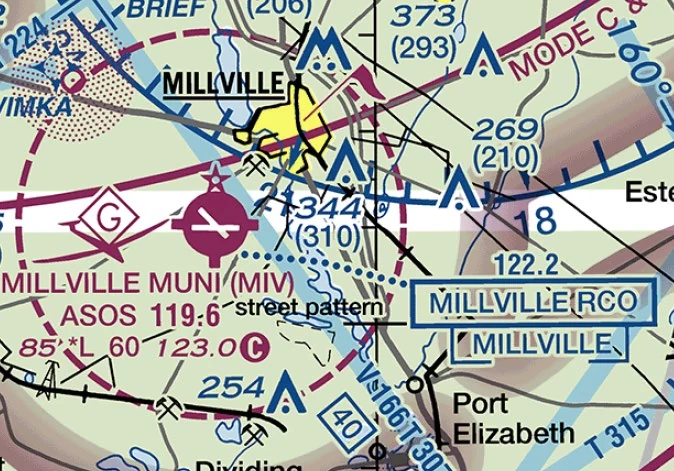
Sample question 1: What type of airspace is associated with MILLVILLE MUNI (MIV) and is ATC authorization required to operate a small UA there?
- Class E that is associated with an airport surface area, authorization is required. This is the correct answer.
- Class G that is associated with an operating control tower, authorization is required.
- Class B that is under the associated Class D airspace, authorization is not required.
Notice what the question demands. You have to recognize the magenta dashed boundary around the airport as a Class E surface area on your own, from the excerpt, with no figure number and no pre-studied chart. Then you have to know that 14 CFR § 107.41 requires ATC authorization there. That is chart reading plus the rule, together.
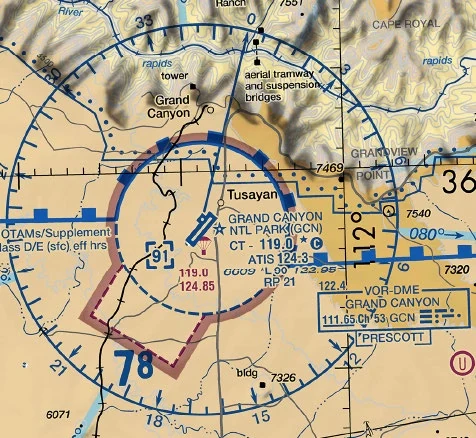
Sample question 2: If GRAND CANYON NTL PARK (GCN) control tower is not in operation, which frequency should be used as a Common Traffic Advisory Frequency (CTAF) to monitor airport traffic?
- 119.0. This is the correct answer.
- 124.3
- 122.95
Here the skill is reading the airport data block. The tower frequency followed by the CTAF symbol (the letter C in a filled circle) tells you that when the tower closes, that same frequency becomes the common traffic advisory frequency. Nothing to memorize in advance, everything readable from the excerpt plus the legend.
What stays the same
| Part of the test | Status |
|---|---|
| 60 questions, 120 minutes, 70% to pass | Unchanged |
| The knowledge areas and ACS codes | Unchanged |
| The rules themselves (14 CFR Part 107) | Unchanged. This is a test format change, not a regulation change |
| Question style: a scenario and three choices | Unchanged |
| Scheduling through PSI, roughly $175 | Unchanged |
One more change worth knowing about from the same advisory: PSI is moving FAA exams to a new Test Taker Portal, targeted for fall 2026. That affects registration logistics, not test content. Check what actually happens at the test for the current process.
How should you study now?
- Learn the airspace depictions cold. Dashed blue is Class D, dashed magenta is a Class E surface area, solid magenta rings are Class C, solid blue rings are Class B. These come up constantly and recognizing them instantly is the core skill the new format tests. Our sectional chart guide walks through each one.
- Practice on live charts, not just figures. Open SkyVector (skyvector.com), pick airports you know, and quiz yourself: what class is this airspace, would I need authorization, what is the CTAF? That mirrors the real test experience better than any fixed figure set.
- Keep drilling the concepts. Regulations, weather, loading, and operations questions are untouched by this change. The chart questions still resolve to the same rules, like § 107.41 authorization, they just present the chart on screen.
- Use old practice tests with one adjustment. The concepts they teach are still right. Just skip any habit of memorizing which answer goes with which figure number.
Our question bank is built concept-first for exactly this reason. Every chart and airspace question drills the depiction and the rule behind it, cited to the FAA source, so what you learn transfers to any excerpt the test puts in front of you.
Drill ten source-cited practice questions a day, see why you missed, and watch missed questions come back until you stop missing them. Free, no signup.